Real Screens, Real Answers
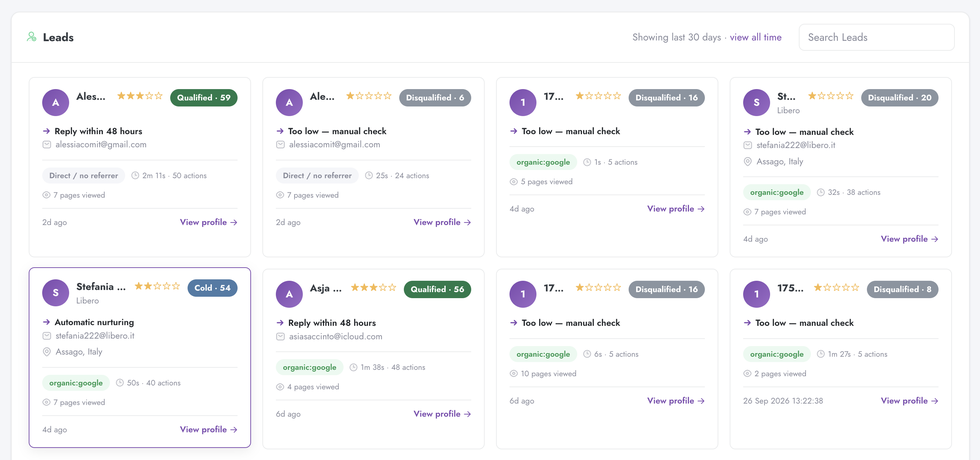
Every card below is a live screenshot from the v2 Lead Intelligence view — no mockups. The product UI ships in English and Italian, and the full scoring suite is live today.
An inbox that triages itself
Every lead lands as a card: star rating, status — Qualified · 59, Cold · 54, Disqualified · 6 — and the recommended next action spelled out in plain words. “Reply within 48 hours.” “Too low — manual check.” “Automatic nurturing.” Source, engagement, pages viewed and recency sit on the same card, so nobody opens a spreadsheet before opening a conversation.
- A recommended action on every card — the model says what to do, not just what to think
- Qualified, Cold and Disqualified states carry the score that produced them
- Source, session time, actions and pages viewed — one glance, one card
Fit — is this your kind of customer?
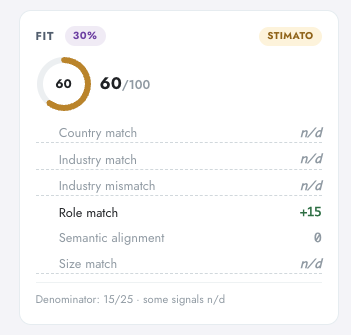
The heaviest-weighted axis (30%) matches the lead against your ICP: role, industry, company size, country, semantic alignment. Role match earned +15 here; the unavailable signals are marked n/d and excluded from the denominator instead of counted as zero — missing data never sinks a lead. 60 out of the 15/25 points actually available, renormalised and shown.
- 30% of the final score — who they are, not just what they did
- Every sub-signal visible: match, miss or unavailable
- Partial data is scored fairly — the denominator shrinks for n/d
Intent — acting like a buyer
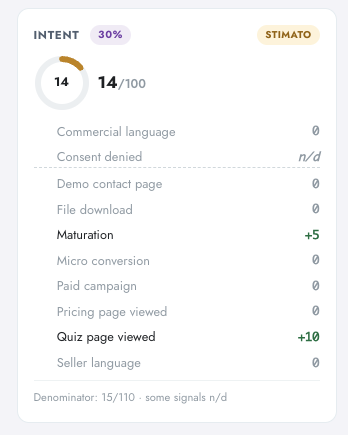
The other 30% axis reads behaviour that money is near: pricing pages viewed, demo and contact pages, quiz completion, file downloads, paid-campaign entry, seller language, maturation over time. This lead viewed the quiz page (+10) and matured (+5) — researching, not yet ready. That reads as nurture, not junk.
- Buying signals, not demographic guesses
- Commercial and seller language parsed from the message itself
- Maturation rewards leads who come back — timing counts
Quality — is the lead real?
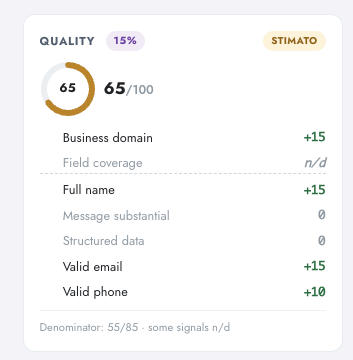
Data hygiene as a scored axis (15%): valid email +15, business domain +15, full name +15, valid phone +10, structured data, message substance, field coverage. This is what separates “a lead” from “a string of characters” — 65/100 here means a real person with thin data. While data is incomplete the card is flagged STIMATO (estimated) — no false certainty.
- Disposable emails and junk die at the gates — Quality scores what survives
- Every field checked signal by signal, points printed on the card
- Estimated badge shown until the data is complete
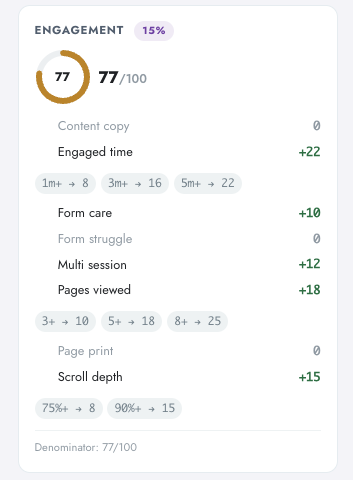
Engagement — researched you hard
Tiered ladders, fully visible: engaged time (1m → 8 · 3m → 16 · 5m → 22), pages viewed (3+ → 10 · 5+ → 18 · 8+ → 25), scroll depth (75% → 8 · 90% → 15), multi-session, form care. You don’t just get the points earned — you see the tier the lead almost hit. 77/100: this person read the site, came back, and cared about the form.
- Every ladder rung printed — how close they came to the next tier
- Multi-session and form-care captured from Smart Track events
- Sales context, not just a number: what they actually did
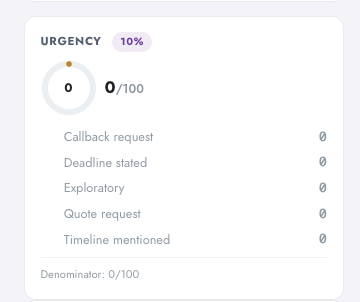
Urgency — needs it soon
The smallest weight (10%), the sharpest signal: callback requests, quote requests, stated deadlines, timelines mentioned, exploratory tone. This lead scores 0/100 — no urgency at all — and that is exactly the point: a zero here correctly means “queue them behind the ones with deadlines.”
- Callback and quote requests score hardest
- Exploratory tone detected separately — nurture, don’t chase
- Kept at 10% so urgency never drowns out substance
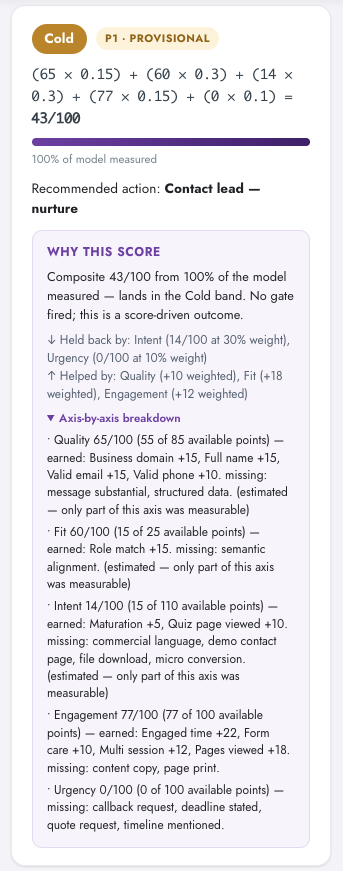
Why this score — no black box
The composite is printed as arithmetic, not mystery: (65 × 0.15) + (60 × 0.3) + (14 × 0.3) + (77 × 0.15) + (0 × 0.1) = 43/100 — Cold band, 100% of the model measured. Then the verdict in plain words: held back by Intent and Urgency, helped by Quality, Fit and Engagement. Every axis expands to the exact points earned and the signals still missing, and while any axis is only partly measurable the badge says PROVISIONAL.
- The formula sits on the card — the whole team reads the same math
- Held-back / helped-by summary — what moved the number, one line each
- The recommended action follows from the evidence: Contact lead — nurture
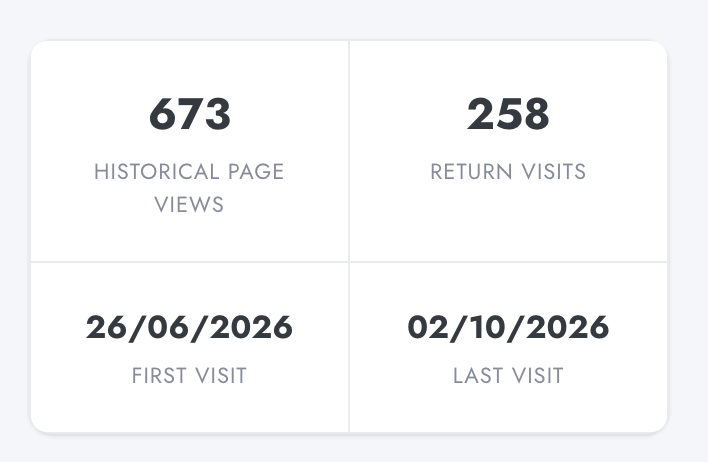
Three months of behaviour in four numbers
Open any lead and the lifetime summary comes first: 673 historical page views, 258 return visits, first visit 26/06/2026, last visit 02/10/2026. Before you write one word of outreach, you know whether this is a drive-by or a long-term researcher.
- Lifetime view — every visit, not just the converting session
- Return-visit count separates researchers from bouncers
- First-to-last span places them in their buying timeline
Every click, in order
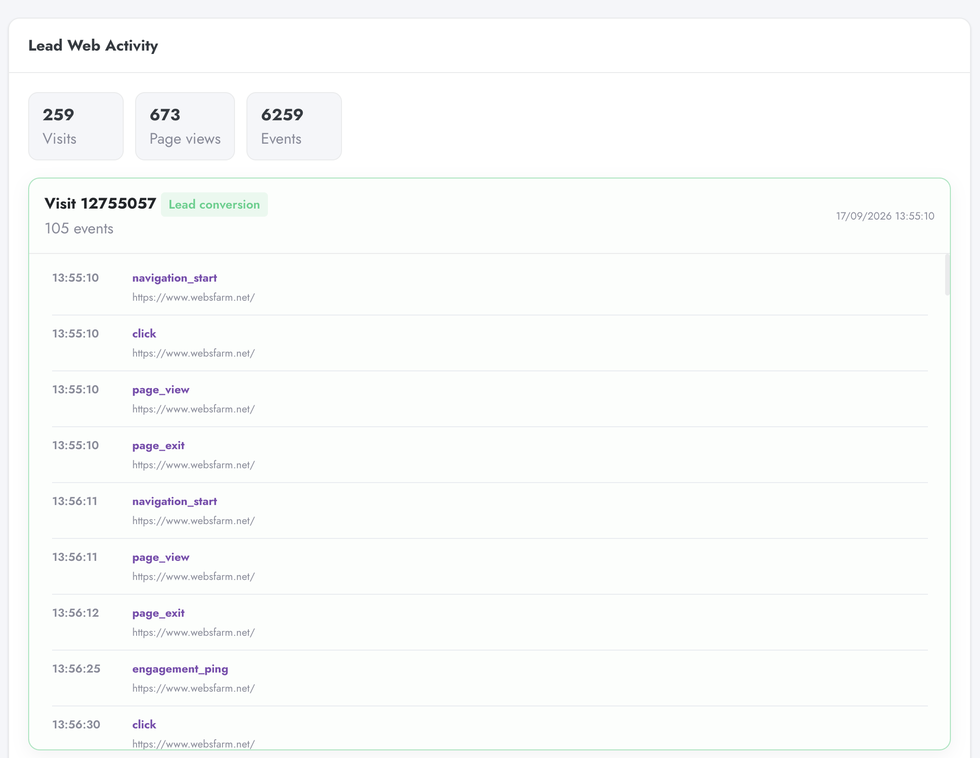
259 visits, 673 page views, 6,259 events — and each visit expands into a timestamped event stream: navigation start, page view, click, engagement ping, page exit. The visit that actually produced the lead is flagged “Lead conversion”, so you can replay the exact session that converted — event by event, back to the first touch.
- The converting visit is explicitly flagged
- Full clickstream per visit — not an aggregate chart
- Event-level history back to the first touch
Who’s behind the email
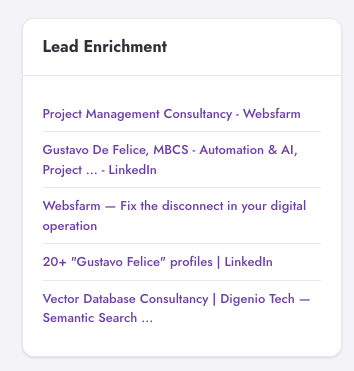
Lead Enrichment attaches the context: company, role, industry signal, matching LinkedIn profiles. “Project Management Consultancy — Automation & AI” stops being an email address and becomes a person you can talk to on their terms.
- Company and role matched from public sources
- LinkedIn profile candidates surfaced automatically
- Enrichment feeds the Fit axis — context compounds
What their website says about them
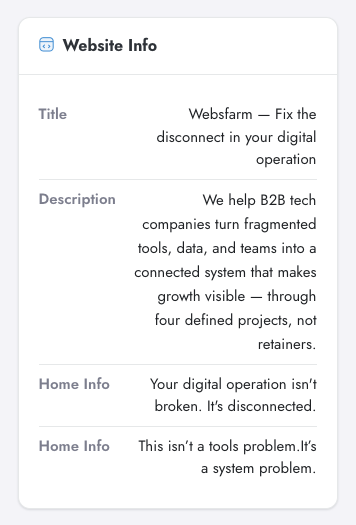
The prospect’s own homepage messaging, captured and summarised: title, description, positioning lines. When your first call opens with their words instead of yours, the conversation starts halfway.
- Title, description and home messaging extracted per lead
- A talk-track ready before the call
- Pairs with enrichment for full first-call context