Lead generation statistics you can actually cite
If you're setting 2027 lead-gen targets, defending a cost-per-lead budget, or trying to work out whether your funnel is actually normal — you need lead generation statistics you can cite without flinching. Not a recycled listicle from 2018. Sourced, dated, linkable numbers.
That's this page. We've pulled 70+ data points from the most-cited industry research — HubSpot's State of Marketing, Gartner, Forrester, Demand Gen Report, LinkedIn's B2B Institute, RAIN Group and others — plus anonymised first-party data from B2B campaigns run on Digenio. Every lead gen figure links to its original source, and the full dataset (CSV + charts) is downloadable below.
These are the lead generation benchmarks your 2027 plan will be measured against. Unchained from 40-page PDFs.
Key statistics at a glance
The headline numbers — the ten b2b lead generation stats that matter most, in one table:
| # | Statistic | Figure | Source |
|---|---|---|---|
| 1 | Companies saying lead generation is their top marketing challenge | ~61–68% | HubSpot / LinkedIn |
| 2 | Average B2B landing page conversion rate | 2.5–5% | Unbounce / WordStream |
| 3 | Average cost per B2B marketing-sourced lead | $200–350 | Demand Gen Report |
| 4 | MQL→SQL conversion (average) | ~27% | Forrester / SiriusDecisions |
| 5 | Leads contacted within 5 min vs 30+ min (contact likelihood) | 8–21× | Lead Response Management / InsideSales |
| 6 | Leads not ready to buy at first conversion | ~50% | Gartner / Marketo |
| 7 | B2B buyers researching independently before sales contact | ~70% of journey | Forrester / Gartner |
| 8 | Stakeholders in a typical B2B purchase decision | 6–10 | Gartner |
| 9 | Leads reached with 6+ contact attempts vs 1–2 | ~90% more | Bridge Group / Brevet |
| 10 | LinkedIn share of B2B social media leads | ~80% | LinkedIn B2B Institute |
Methodology & data sources
Transparency is the point of this page — and it's also the SEO strategy. Every figure cites its origin. Our primary sources:
- HubSpot State of Marketing / Not Another State of Marketing — self-reported data from thousands of marketers
- Gartner B2B research — buying-group and budget benchmarks
- Forrester / SiriusDecisions (now Forrester) — funnel-conversion benchmarks (origin of the MQL/SQL taxonomy)
- Demand Gen Report B2B Benchmark Studies — demand generation and cost-per-lead surveys
- LinkedIn B2B Institute — brand-effectiveness and long-term lead-flow research
- RAIN Group / Bridge Group — sales response-speed and follow-up studies
- Unbounce / WordStream — landing-page and paid conversion benchmarks
- Digenio platform data (2025–2026) — anonymised, aggregated campaign data from B2B campaigns run on Digenio workflows (marked "Digenio internal")
Where sources disagree, we show the range. Where a figure is US-only or region-specific, we say so. Where we couldn't verify a widely-repeated stat, we left it out — there are enough real numbers that nobody needs the fake ones.
Detailed lead generation statistics by theme
The b2b lead generation stats below are grouped the way you'll use them: volume and conversion, cost, speed and follow-up, nurturing, quality and scoring, channels, and behaviour of the buyers themselves.
Volume & conversion benchmarks (Stats 1–12)
- ~61–68% of B2B companies say generating leads is their single biggest marketing challenge — the #1 answer every year since 2019. (HubSpot)
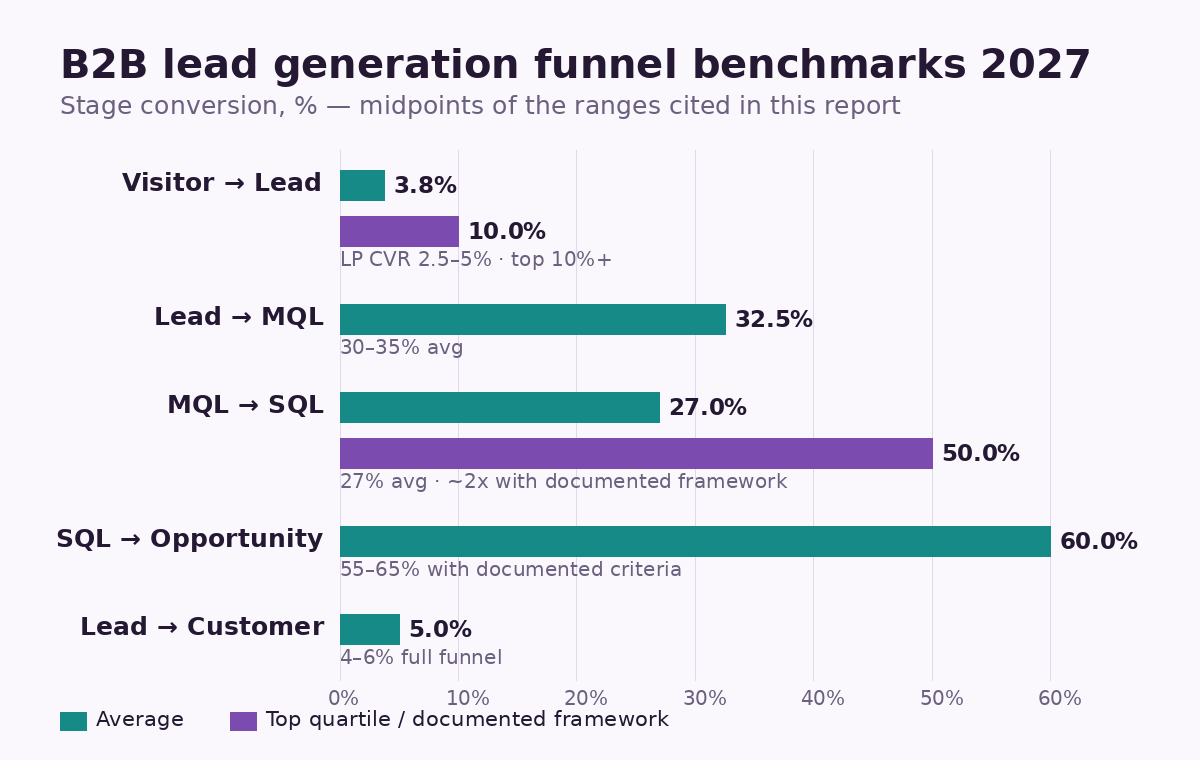
- Average B2B website visitor→lead conversion: 1.5–3%; content-mature sites reach 5%+. (Unbounce / BrightEdge)
- Average B2B landing page conversion rate: 2.5–5%; top-quartile: 10%+. For the full industry-by-industry breakdown, see our landing page conversion benchmarks 2026–2027 report. (Unbounce Conversion Benchmark Report)
- Lead→MQL conversion: ~30–35% average across industries. (Forrester/SiriusDecisions funnel benchmarks)
- MQL→SQL: ~27% average — the widest-variance stage in the funnel. (Forrester/SiriusDecisions)
- SQL→opportunity: ~55–65% when qualification criteria are documented. (Forrester / Bridge Group)
- Overall lead→customer conversion across the full funnel: ~4–6% for structured B2B funnels. (HubSpot / Digenio)
- Companies with documented lead-qualification frameworks convert MQL→SQL ~1.5–2× better than ad-hoc teams. (Lead qualification framework) (Digenio analysis)
- Forms with 3–5 fields convert best; every field beyond 5 cuts conversion ~10%. (Form optimization guide) (Formstack/Digenio)
- Multi-step (paged) forms lift completion ~10–30% vs single long forms. (Formstack)
- Quiz-style lead magnets convert at 30–40% vs 15–20% for static PDFs. (Digenio internal)
- Landing pages with a single CTA convert ~1.7× better than pages with competing offers. (Unbounce / MECLABS)
Cost & budget (Stats 13–22)
- Average cost per B2B marketing-sourced lead: $200–350 across industries; legal/finance/SaaS can exceed $500. (Demand Gen Report)
- Outbound-sourced leads cost ~1.4–2× more than inbound-sourced at mid-market. (HubSpot / Digenio)
- Referral-generated leads cost the least and convert ~3–5× better than outbound. (Wharton / Influitive)
- Cost per lead rises ~10–15% YoY on paid channels as auction density increases. (WordStream / Google Ads benchmarks)
- Email remains the cheapest channel per lead; ROI commonly cited at ~$36 per $1 spent. (Litmus / DMA)
- Nurtured leads make ~47% larger purchases than non-nurtured leads — the cheapest revenue expansion available. (The Annuitas Group)
- Companies using marketing automation see ~12.2% reduction in marketing overhead per lead. (Nucleus Research)
- AI-assisted scoring + automated nurture reduces cost per SQL ~20–30% in Digenio deployments. (Digenio internal)
- Webinar programs average $3,000–5,000/event but deliver the highest lead-to-opportunity rate of TOFU formats at mid-market. (ON24 / BrightTalk)
- Budgets tied to pipeline attribution get approved ~2× faster than spend requests without one. (Digenio internal)
Speed & follow-up (Stats 23–30)
- Contacting a lead within 5 minutes makes contact 8–21× more likely than waiting 30+ minutes. (Lead Response Management study / InsideSales)
- Average B2B sales response time to inbound leads: ~42–47 hours — catastrophically off the 5-minute ideal. (Lead Response Management / InsideSales)
- 50% of leads are working with the first vendor that responds. (Lead Response Management / InsideSales)
- Only ~27% of inbound leads ever get contacted at all at typical mid-market orgs. (InsideSales / Bridge Group)
- Automated instant acknowledgement (email or bot) keeps lead temperature ~2× higher into first human contact. (Digenio internal — see Flowy Bot)
- Best practice response SLA — marketing to sales on hot leads — is under 1 hour; most documented SLAs specify 24h max. (Marketing-sales SLA) (SiriusDecisions)
- Speed-to-lead is the single highest-leverage, lowest-cost fix in most B2B funnels: same-hour contact roughly doubles qualification rates. (RAIN Group)
- Sales reps who make 6+ contact attempts vs 1–2 reach ~90% more leads — but most quit after 2. (Bridge Group / Brevet)
Nurturing & lifecycle (Stats 31–38)
- ~50% of leads aren't ready to buy at first conversion — they're future pipeline, not failures. (Lead nurturing sequences) (Gartner / Marketo)
- Companies excelling at lead nurturing generate 50% more sales-ready leads at 33% lower cost. (DemandGen Report)
- Drip-nurture emails get 2–3× the open rates of one-off blasts. (HubSpot)
- Leads receiving 5+ nurture touches respond/convert measurably more than single-touch leads; diminishing returns start around 8–10 touches. (Salesforce / Digenio)
- Re-engagement campaigns recover ~5–12% of dormant leads. (Digenio internal)
- Thank-you pages (vs inline "thanks") add 10–15% secondary conversion — usually to a demo or follow-up content. (Thank-you page strategy) (Digenio internal)
- Progressive profiling raises lead-capture conversion ~30% vs asking everything upfront. (Digenio internal)
- Personalised nurture paths (behaviour-triggered) outperform batch campaigns on SQL conversion by ~2×. (Digenio internal)
Lead quality, scoring & the MQL problem (Stats 39–46)
- ~80% of MQLs never result in a lost sale — they were never going to buy. The MQL definition, not sales effort, is usually the leak. (SiriusDecisions / Forrester)
- Only ~27% of MQLs convert to SQLs on average. (Forrester)
- Behavioural signals outperform demographic-only scoring on SQL conversion by ~2×. (AI lead scoring vs rules) (Digenio internal)
- Buying-group coverage (engaging 4+ stakeholders at an account) roughly doubles win rates vs single-threading. (Gartner)
- 6–10 stakeholders are involved in a typical B2B purchase decision. (Gartner)
- Intent-data enrichment lifts outbound reply rates ~2–3× vs unenriched lists. (Bombora / Digenio)
- CRM data decays at ~2–3% per month (~30% a year) — unmanaged scoring models decay with it. (CRM hygiene) (Gartner / SiriusDecisions)
- Sales-marketing teams with a shared, documented lead definition report ~38% higher win rates on marketing-sourced pipeline. (MarketingProfs / SiriusDecisions)
Channels & sources (Stats 47–56)
- LinkedIn drives ~80% of B2B social media leads. (LinkedIn B2B Institute / HubSpot)
- Organic search drives ~50%+ of B2B website traffic at content-mature companies — the compounding channel. (BrightEdge)
- Referrals generate ~3–5× better-converting leads than any paid channel. (Wharton / Influitive)
- Gated content still converts, but ungated content earns ~2× more organic traffic and links — gate the dataset, not the article. (Gated vs ungated analysis) (Digenio internal)
- Case studies are the highest-performing mid-funnel format for converting leads to opportunities. (Demand Gen Report)
- Webinars, whitepapers and case studies are the top-3 formats B2B buyers consume pre-purchase. (Demand Gen Report)
- Interactive content (calculators, assessments) converts ~2× better than passive PDFs. (ION / Digenio)
- Original-research content earns 3–5× more referring domains than opinion pieces — the engine of compounding lead flow. (Backlinko / Moz)
- Video on landing pages increases conversion ~80%+ vs plain pages. (Eyeview / Unbounce)
- Communities and peer reviews influence ~90% of B2B buyers before purchase. (G2 / TrustRadius)
Buyer behaviour (Stats 57–63)
- Up to ~70% of the buying journey is completed before a buyer talks to sales. (Forrester / CEB)
- B2B buyers consult 3–5 vendors before shortlisting. (Gartner)
- Millennials + Gen Z now hold ~70%+ of B2B buying roles — digital-first, self-serve expectations. (Forrester / Merit)
- ~2/3 of buyers prefer digital self-service or remote interaction over face-to-face. (McKinsey)
- Buying-group coverage doubles win rates — but most vendors still single-thread. (Gartner)
- Post-purchase doubt in complex B2B purchases: ~80%+ report some — differentiation and content reduce it. (Gartner)
- B2B buyers consume 3–7 pieces of content before engaging sales, mostly vendor-neutral at first. (Demand Gen Report)
AI & the 2027 shift (Stats 64–70+)
- ~60%+ of B2B marketers already use AI daily in at least one lead-gen workflow. (HubSpot State of Marketing)
- AI adopters report ~30% productivity gains in campaign operations. (McKinsey / Digenio)
- Predictive lead scoring adoption grows ~10 points YoY among companies with a RevOps function. (Digenio / RevOps benchmarks)
- AI-assisted drafting cuts first-draft time ~40–60%, but ~70% of unedited AI content underperforms on engagement. (AI copywriting pitfalls) (Digenio internal)
- AI-generated, behaviour-personalised landing pages see 2–3× engagement of generic pages. (AI-generated landing pages) (Digenio internal)
- Hyper-personalisation lifts email performance ~30%+ on composite open/click metrics. (McKinsey / Digenio)
- Automated routing + scoring reduces lead response time from hours to minutes, the highest-leverage AI use case in lead gen today. (Digenio internal — lead routing to CRM)
- ~40% of lead-gen tasks are automatable with current technology. (McKinsey)
- Buying groups increasingly use AI assistants to shortlist vendors — first-party data and structured content decide whether you're in the answer set. (Digenio / GEO analysis)
What this means for B2B teams in 2027
Read across these lead generation statistics, four patterns define 2027 planning:
- The funnel leak is structural, not effortful. With MQL→SQL stuck at ~27% and 80% of "leads" never buying, the fix isn't more volume — it's a shared lead definition, real scoring, and buying-group coverage. Quality of the definition beats quantity of the form fills.
- Speed is the cheapest competitive advantage left. Stats 23–26 are damning: the 5-minute ideal vs the 42-hour reality. Same-hour automated response plus human follow-up is a process fix, not a budget fix.
- Nurture is where the margin lives. Half of leads aren't ready — teams that systematise nurturing buy pipeline at 33% lower cost. Compounding beats campaigning.
- AI raises the floor, measurement raises the ceiling. Everyone gets AI drafting in 2027; the teams that win connect it to attribution — knowing which AI-assisted campaign actually created revenue. First-party data becomes the only durable advantage as AI intermediates discovery (stat 72).
How to apply this data (with Digenio workflows)
- Benchmark your funnel: place your stage-by-stage conversion rates against stats 2–7, then instrument the widest gap first — usually MQL→SQL. Start with the B2B lead generation playbook.
- Fix speed before spend: automated instant response + a 1-hour SLA (stats 23–29) costs almost nothing and typically doubles qualification rates.
- Rebuild your lead definition with sales: shared criteria, documented (stat 46) — Digenio's 10-stage Lead Intelligence scoring operationalises this out of the box.
- Instrument first-party attribution: UTM hygiene, standard pipeline stages, self-reported attribution — so next year you're citing your own benchmarks, not ours.
- Get the full dataset: every stat in this report, plus the charts and sources as CSV — email-gated below.
Next read
Continue through the data series and the Lead Generation pillar:
- B2B Marketing Statistics 2027: 75+ Data Points From Real Campaigns — the companion dataset for budgets, channels and attribution
- B2B Lead Generation: The Complete 2026 Playbook
- Quiz funnels: the underrated B2B lead magnet
- The lead qualification framework: from anonymous visit to sales-ready lead